Understand what Australia's mandatory climate reporting laws mean for your business — and get practical support to prepare
Expert guidance
Climate reporting in Australia has moved from something businesses chose to do, to something many are now required to do by law. The rules are detailed, the terminology can be confusing, and the compliance dates differ depending on the size of your business. It’s a lot to take in, especially if this is new territory for your board or leadership team.
Green Moves helps businesses make sense of what’s required, where they sit in the timeline, and what practical steps to take next. Whether you’re already legally required to report or getting ahead of requirements that are coming your way through your supply chain.
What are the Australian Sustainability Reporting Standards, and do they apply to my business?
The Australian Sustainability Reporting Standards (ASRS) are a set of new legal requirements for Australian businesses to disclose their climate-related risks, opportunities and greenhouse gas emissions.
You’ll often hear them referred to simply as ASRS, or as mandatory climate reporting — same thing, different names. They’re built on two standards issued by the Australian Accounting Standards Board (AASB):
AASB S2 Climate-related Disclosures — the mandatory standard. It sets out exactly what businesses need to disclose about their climate-related risks, opportunities and emissions.
AASB S1 General Requirements for Disclosure of Sustainability-related Financial Information — the broader sustainability framework AASB S2 sits within. AASB S1 is currently voluntary in Australia, but it shapes how climate disclosures fit into the bigger financial reporting picture.
These standards carry legal weight through the Corporations Act 2001, as amended by the Treasury Laws Amendment (Financial Market Infrastructure and Other Measures) Act 2024. This is what makes climate reporting mandatory, rather than best practice.
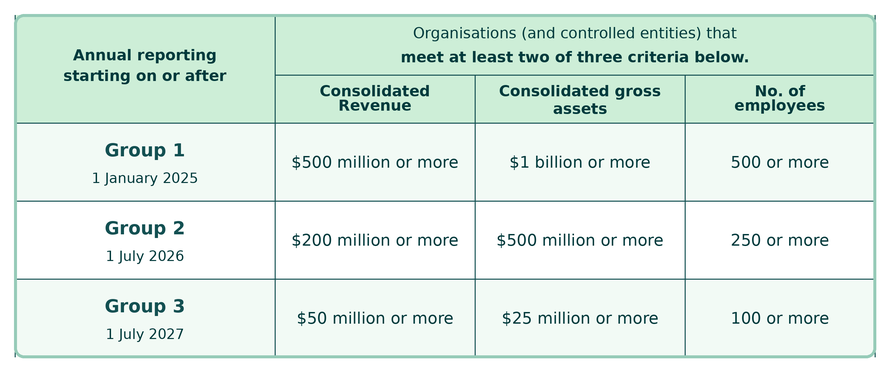
The requirements are being phased in over three years, based on business size.
Which group does my business fall into?
Each group is defined by size, measured against three factors: consolidated revenue, gross assets, and employee numbers. Entities need to meet two of the three thresholds for their group.
Note: These thresholds are current as of 5 August 2026. The Federal Budget has proposed raising Group 3’s thresholds, but this hasn’t been legislated yet.
If your business doesn’t meet the size thresholds directly, it’s still worth paying attention. Large reporting entities are increasingly asking their suppliers and partners for emissions data to meet their own disclosure requirements — so climate reporting readiness is becoming a business expectation well beyond the businesses legally required to report.
Since 2009, we’ve helped small and medium-sized businesses across Australia understand and act on their sustainability obligations. Mandatory climate reporting is a natural extension of the work we already do — measuring emissions, understanding what matters most to a business and its stakeholders, and turning that understanding into a clear, practical plan.
We won’t tell you it’s simple, because for most businesses it isn’t. But we can walk you through exactly what’s required, help you understand where the genuine priorities are, and support you in building the systems and evidence you’ll need — at a pace and scope that suits your business.
All advice you receive from Green Moves is independent and grounded in what your business actually needs, not a one-size-fits-all compliance checklist.
Understanding your emissions is the foundation of any climate disclosure. Our carbon inventory service measures your business’s Scope 1, Scope 2, and Scope 3 emissions, giving you the data your climate statement needs to be credible.
Not every climate risk or opportunity is significant to your business. A materiality assessment identifies which climate-related issues genuinely matter to your business and your stakeholders — a required step under AASB S2, and the evidence base for the rest of your disclosure.
Beyond identifying what’s material, AASB S2 asks businesses to explain how climate-related risks and opportunities could affect their operations, strategy and finances over the short, medium and long term. We’re building out our capability in this area to support clients through it.
AASB S2 requires businesses to test how resilient their strategy is under different climate scenarios. This is one of the more technical requirements of the standard, and an area we’re developing dedicated support for.
Once risks, opportunities and targets are identified, businesses need a way to track and report progress against them over time. We’re developing our approach to help clients set up metrics and targets that hold up to scrutiny — and that are genuinely useful to the business, not just the report.
Green Moves is not required to report, but we are aligned with AASB requirements, so we understand what’s actually needed firsthand, not just what the standards say on paper. We’re a certified B Corporation and certified carbon neutral for our business operations by Climate Active, and will remain certified until the program ceases in June 2027.
If mandatory climate reporting is new territory for your business — or you know it’s coming and want to get ahead of it — a conversation with Green Moves is a good place to start. We’ll help you understand exactly where you stand, what’s required, and what to prioritise first.
Stay in touch
Stay informed on all the latest updates and developments.
Take charge of reducing your carbon footprint. Get in touch with Green Moves today.